Saturday, January 25, 2014

¡Bandera Chilena!

Abrazo flies the Chilean flag at last: 

Richard took down the US flag, and then moved the Chilean flag from the "guest" position to its new place on the boat.  
The Chilean Customs bureaucracy has officially accepted the valuation of Abrazo as calculated by the tasador from a certain prestigious empressa out of Viña de Mar.  We’re specifically grateful to the tasador, himself, a young man whose Chilean ancestry traces back to the northern Italian area of Milan/Lago Maggiore from whence Richard himself descends.  This appraiser admired Abrazo immensely, inspected her thoroughly, required scans of her original plans, took the book I wrote about her construction in Bellingham, as well as the For Sale flyer (posted in an earlier blog), and also understood that R was going to have to pay a tax of 20+% of the boat’s official value.  We’re grateful to the Agente de Aduana, Sr. Arturo Bello, for his shepherding of the flock of papers through the Customs process.  He charged plenty, siValió la pena, esperamos.
Several bankers played their parts faithfully as the thousands of US dollars were transferred across the country to New York City, and thence over the wires into the Chilean system.  Richard has complied with every request made by his chosen bank here in Puerto Montt, but they are not quite ready to let him have a checking account yet.  So when the money came in from the US, he had to take it en efectivo, cash ... and the largest bills available were 10,000 peso notes.  There must be a better way than taking a six-inch deep stack of paper pesos from one bank and having to carry it four blocks to the bank where the Agente de Aduana has HIS account … but that’s what we did.  I went along as bodyguard.  All's well.    


So, now:  Richard will adjust the sales price to reflect the fact that a buyer will NOT have to pay the 20% IVA.  The dollar is highly valued down here right now, around 540 pesos per.  Pricing is the new challenge.  Right around $56,000 US is the target, I believe.   

But it's not all work.  We had a wonderful time last weekend at a gorgeous performance of Mozart’s opera, The Magic Flute, La Flauta Magica.  
Neither of us knew anything about this work, but our Pennsylvania amiga, Nancy, has infected us with her enthusiasm for the opera, so we jumped at the chance to experience this music in the “world class” Teatro Del Lago in Frutillar.  You can't just call in your credit card number to reserve seats here.  You must call to reserve tentatively, then look for the email from the theater giving you their bank account info.  You email the theater when you've made the deposit, and they ask you to send a photo of the receipt!  Then you've got reservations.  What a system.  

Main floor ... we arrived early.  


 The pic I took of Richard in his balcony seat did not turn out well, but here he is, outside the theater, dressed for the opera.

We enjoyed the sopranos immensely, and the great bass voice of Sarastro impressed us.  It took me a week, after the performance, to read the program and understand the story, finally.  I just loved the way the two young men, Prince Tamino and the bird-hunter, Papageno, each followed his own path to success:  one by the righteous road, supervised by the wise old men, and passing thru hard trials, tests of character; and the other by the natural, winding, happy path of instinct, holding to pursuit of pleasure above all things!


Ah, there's more to tell of that trip to Frutillar:  a delicious lunch at the Lavender Casa de Té, where Kristina, the owner gave us a walking tour thru her blueberry grove and then up into the horse pasture to meet the studs and geldings and enjoy the view of hayfields, woodlots, acres of lavender a-buzz with honey bees, and the beautiful lake, Llanquihue, sparkling across to the volcanoes.
We stayed in a great farmhouse built by German colonists more than a hundred years ago, far on the other side of town from the theater.  Our transportation funds mostly went to a young man named Javier, who delivered us back and forth 3 of the 4 trips.  He brought his wife and two small sons along on Friday night when he met us outside the opera house for the 6 km drive along the lake shore, under the full moon, to our lodging.  And I'm sure he was sorry to hear that our last ride with him the next day was to the bus terminal so we could get back to Puerto Montt.

Next adventure, well, besides selling the boat, is north on Ruta Cinco for about 5 hours on the bus to Temuco, where Richard will rent a car.  We want to go to the tiny town of Capitan Pastene.  Brother Bob saw a PBS documentary about this town and told us about it last week.  The colonists who started the town in 1904 came from Modena, Italy and have made themselves famous for their Italian cuisine in the mountains of Chile's south-central region.  We hope to feast on prosciutto and pasta.  Then we'll get down to the business of marketing Abrazo.


Friday, January 10, 2014

¡Atropellada! in Frutillar


El Museo Aleman (the German Museum) in Frutillar inspired all kinds of sense memories for both Richard and me, including some from past lifetimes, I think.  
What a fine way to lay out a display!  The millhouse with its waterwheel sits well above the entrance gardens, yet far below the family farmhouse at the top of the hill. A spring house up there, outside the family home, where Mama kept her butter and her cottage cheese for cooling, marks the place where the water starts, in a stream that falls downhill thru green channels and rocky patches till it's channeled into a wooden chute to turn the water wheel. 

No está functionado ahora.   But the various millstones that used to grind the grains lay about.  Coarse meal, fine flour ... the miller could do it all.  

In the Perkiomen River Valley, where I grew up, at least three mills once worked the waters near my home.  Leidy's, Clemmer's, and Pennypacker's water wheels had ceased to function by the 1950's, but their names and their powers continued into modern commerce.  
Richard, born with a mechanical turn of mind, to a father who built dams for hydropower in the great Northwest, saw the power of the turning wheel clearly enough to recognize that this contraption was a lathe:  

No doubt the lathe was used to turn the banisters for the stairways inside the family home ... and what else, we wonder? 

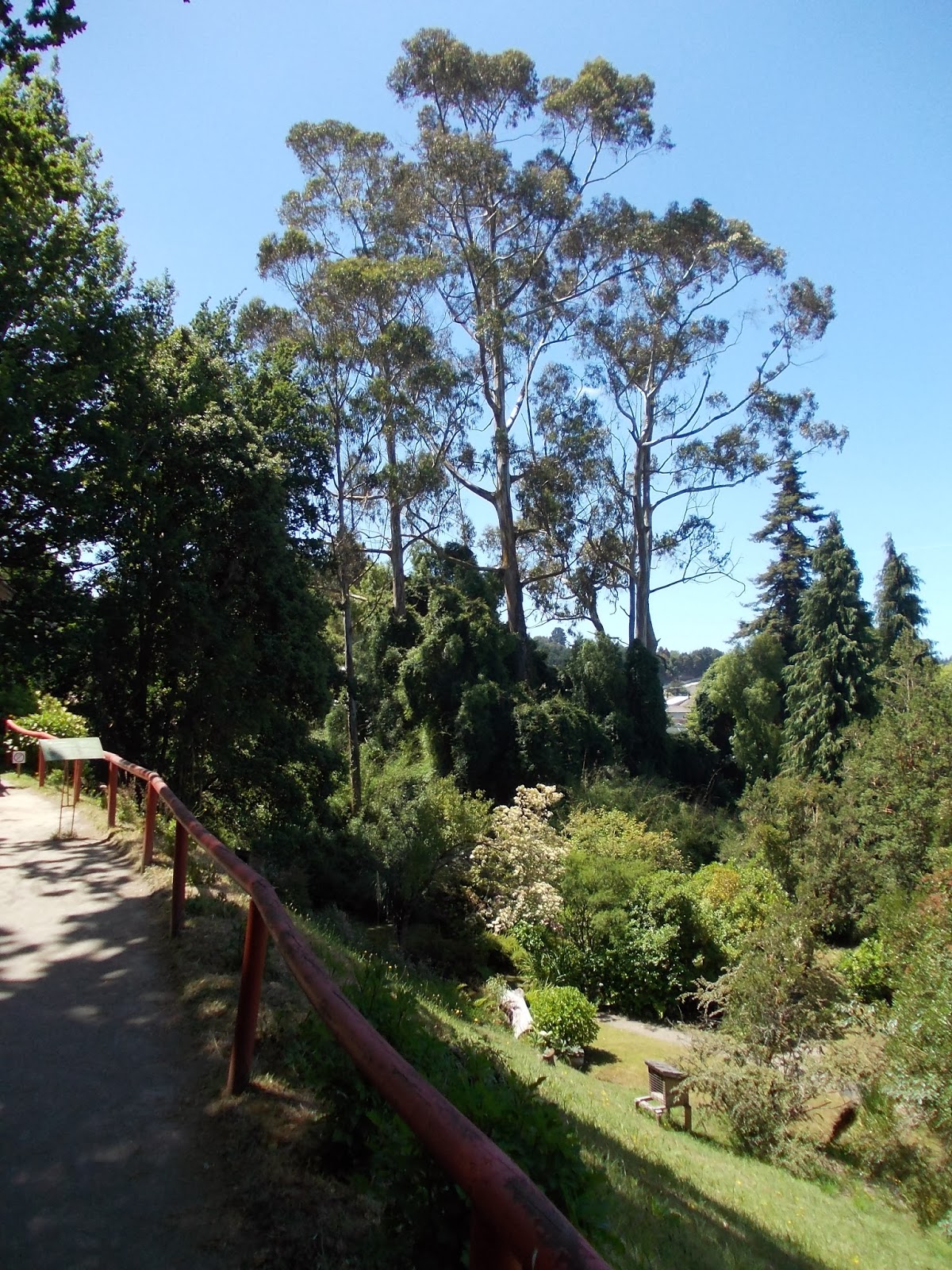
On the way up the trail to the main house, we had a sweet view of the eucalyptus trees on the border of the museum property. These trees always connect us to Richard's Auntie Marian, whose home in Los Gatos, CA was surrounded by them.  
The eucalyptus also links us to our first visit to Chile in 2005 when we learned that Isidora Goyenechea de Cousiño introduced the tree to Chile because she'd discovered that its wood was really good for bracing the coal-mining tunnels in Lota.  Eucalyptus beams gives off a loud creak when moved or strained ... an appropriate alarm method in Lota's underground mining shafts that go for almost a mile below the ocean floor.   


Inside the Casona, many warm interior scenes of family life are easy to imagine.  The kitchen, for instance:  

Is that a bread-slicing device on the counter at far right?  I like the cast iron waffle iron on the table.  We had one of those on our boat, for cooking waffles atop the wood stove.  

I love the clean and sunny look of the "bath room" ... .  Can't help wondering, now that I think of it:  How did they get the used water OUT of those tubs?  With bailing buckets?  Throw the water out the window?  


Each room has special features; each has fine views from the windows.  I would love to have stepped into the nursery to have a better look at that castle/doll house!  


The view from the porch at the back of the house, face to face with Volcan Osorno across the lake. 

 Hedged gardens adorn the lower acres, with a blacksmith’s house and a barnful of ancient farm equipment on either side of the winding creek.  One more photo:  I'm only standing there for scale, so you can appreciate how big that agave plant is.  

Our tour thru the German Museum came at the end of our day in Frutillar.   

We'd enjoyed a delicious lunch of smoked salmon salad, and pork tenderloin with sauteed veggies at the Bistro in the Teatro del Lago ... where we made plans to return mid-month for Mozart's La Flauta Magica. 
In the shade of a huge tree on the lakeside, we enjoyed a free performance by the youthful orchestra from the town of Mellipuhue.  They warmed up with a circus theme from Strauss, and then enchanted us with their version of  El Pantero Rosado by Henry Mancini.


And now for the title story:  ¡Atropellada!  
When we first arrived in Frutillar, by bus from Puerto Montt - about an hour's ride - we walked a long ways around the lake, beyond where the sidewalk ends.  Richard wanted to see the marina, where 12 or so boats were moored, including three J-24's, the kind his buddy Carlos likes so well.  We had a good time talking about what it might be like to live in this lovely town on the very pretty lake, Llanquihue.  What might lake sailing be like?  
On the walk back towards the main attractions of Frutillar, we crossed the road at one point because maybe there was a little more of a grassy shoulder on that side.  I'm sure I MUST HAVE SEEN that broad, big, dark green road sign up ahead.  Maybe my mind registered:  big road sign - must be high enough for a normal woman to clear, walking underneath?  Or, maybe my mind was too much focused on watching the narrow, uneven ground.  Maybe the sun would have been in my eyes if I'd been looking up.  Maybe my sunglasses were smeared with sweat that blinded me.  Whatever!
I was marching along behind Richard, eyes on the ground, head tilted down, when that road sign, a billBOARD, knocked me down.  Crack went my skull against the sharp aluminum edge at the bottom of the sign, and down I went on my butt and left elbow.  What a shock!  And even more shocking:  the hot blood dripping and then flowing down the left side of my face!  Richard was very kind.  He sloshed water from his private stash, fished in my pack for the packet of kleenex I always carry, and swabbed my head wound - an inch wide gash at center scalp, two inches above my hairline.  He had me hold a wad of kleenex on the torn spot, while he dabbed away the blood on my face and hands, and even flooded the bloody spots out of my blouse while I recovered equilibrium.  Never a word of ridicule about not watching where I was going.  In fact, he tried to take the blame.
All's well.  Good to have these humbling incidents now and then, as long as we survive them, right?  

May your own focus on where you put your feet never distract you from what might whack your head!  


Friday, January 3, 2014

Mortars, Luck, Lentils & Loros

2014! 

                          
Imaginations firing in full color at the turn of midnight from the Old to the New Year, Richard and I lay abed, eyes closed.  We'd been awakened by the mortars of Puerto Montt exploding their first loads of los fuegos artificiales out over the bay.  Shouts of approval rose from the gente outside our building, cries of delight emanated from the balconies and windows above & below us – still we did not get up to look out the windows.  For twenty minutes, ¡muy forte! the blasts continued. I’m sure it was a glorious display.  The next day's newspaper confirmed what my mind had fully enjoyed.  

What a miracle that the cold rain that had been threatening since late afternoon did not begin to pound the town till three minutes after the last blast! 

Surely that’s a sign of luck for 2014. 

Forgive me:  I did not know that it was NOT good luck to say Felice Año Nuevo before midnight.  When I returned from the Jumbo with my last minute groceries on Tuesday afternoon, and wished the conserje who let me into the building a Happy New Year, he wagged his index finger at me and said “No, no, no.  A las doce, o a la manyaña!” 

Whoops!  ¡Por favor, disculpa me! 

That bad luck error probably caused whatever cold germs I'd exposed myself to at the grocery store to develop into the sore throat and sniffles that have plagued my 2014 so far.  Life is better today, now that I’ve been BACK to the Jumbo for some real Kleenex, and don’t have to blow my nose in rough paper towels. 

It’s all relative, right?   And there are different kinds of luck.  We had lentils for dinner on New Years Day, and thanks to a Skype chat with Cousin Davide of Ternate, Italy, we know that's a recipe for economic fortune in the New Year.

Our friend G came up to our place for dinner and conversation on NYE, and Richard's excellent risotto satisfied us well.  I'd neglected to take my lemons out of the freezer ahead of time, thinking I could simply grate the frozen fruit for the pisco sours G wanted to make.  (Have you seen that Facebook post about using the WHOLE lemon to get full benefit of its amazing vitamin power?)  We didn't give the grated lemon a fair chance, in my opinion, and ended up thawing the darn lemons till we could juice them, by which time it was really too late for pisco sours!  Who knew G was such a traditionalist?

Speaking of tradition:  the week before Christmas we'd walked to the plaza and captured this view of Puerto Montt's manger scene, all carved from wood.
 Something's missing, though.


Our Christmas Day entertainment was most enjoyable.  Chris and Margi of Hobart, Australia, left their cozy boat in the marina to join us for a midday feast of champagne, hors d'oevres, garlic-roasted chicken (only slightly overdone), spinach pie, green beans almondine (or, more precisely, green beans with blackened almonds, as I left the toasting almonds on the gas burner at a crucial moment to show Margi the Christmas cookies our neighbor, Yolanda, had given us), delicious wine.  We also had perfectly boiled potatoes:  Richard managed to conjure his Grandfather Edwards, who would mash the potatoes just so on his own plate before distributing them onto the grandkids' plates.  We talked religion and politics without any grief, shared cruising tales and harbor gossip, and sight-seeing plans.  R rolled out his charts of the Guaitecas Islands, south of the Gulf of Ancud, to point out places where he'd anchored, as well as places where he'd given up trying to anchor.
Chris and Margi had prepared their traditional Christmas treat:  an authentic English Plum Pudding with Brandy Sauce for our dessert.  What a delight! - and a totally new experience for us.  Please test your imagination and share a spoonful of this warm, spice-flavorful, fruit-rich (yet delicate!) elaboration, drenched in buttery brandy cream.  May it melt in your mouth, bring radiance to your throat and flow caloric bliss through your bloodstream!  

Margi commented that the Christmas creche at the marina had finally been completed by the addition of the baby in his manger.  The gate guard there confirmed for her that Chileans do not expect to see the Baby Jesus until AFTER midnight on December 24th.

Back at the plaza, on the day after Christmas:  sure enough. And there's an angel on top of the "tree," now, too.


Also, couldn't help capturing this chica puertomontina with her Navidad presents on display:  


The local loros are sleeping a little later now that the year has turned.  A certain gang of these green parrots live in the trees just below our windows.  The loro's screech regularly pierces the densest dream in the dark of night. Don't know what had been setting them off at 4 a.m the past few weeks ... hungry baby loros? ... But maybe the trend has passed.  I didn't hear them this morning.

Who knows how this New Year will turn out for all of us?  We hope your good luck outweighs the bad.  Or at least, as they say in Panem, at the start of the Hunger Games, "May the odds be in your favor."  

Monday, December 16, 2013

Socialists, Social Events, and Associations

Sunday, December 15, 2013: “ Michelle Bachelet Easily Regains Presidency”…
Today was the run-off election.  None of the 11 candidates who ran on Nov 17 had a certain majority.  Chileans have now re-elected Bachelet, the center-socialist, and maybe she'll use her position wisely.    http://www.usatoday.com/story/news/world/2013/12/15/michelle-bachelet-chile-presidency/4033693/

Recent Social Events in Puerto Montt: 

Frauenverein
Our neighbor in the apartment next door is Yolanda, a lovely woman of la tercer edad, who gave me a ticket to the traditional Christmastime Onces party by the Frauenverien of Puerto Montt.  Women of German descent, they do good works in the community, and hold these parties a couple times a year to raise money for their causes.  We gathered in the large hall of the Club Aleman, where thirty big round tables were set with plates of petit four sandwiches, cookies, and cakes of every kind.  Champagne glasses of freshly minced strawberries topped with sparkling soda, marked each place, and every table had a big bowl of Nescafe instant coffee, a pitcher of hot milk and a thermos of hot water.  (Photo is from the Club Aleman website ... there really were 30 tables, each set for ten, and every seat held a lively, lovely woman!) 
Yolanda sat me next to an English-speaker named Ursula, a young woman who told me she's known most of the women in the club since she was a child. She was attending with her mother, and many tables, she said, included three generations of women from the pioneer German families of Pto Montt.  During the first hour of chatting, sipping and nibbling, club members circulated among the tables selling tickets for the raffling of prizes.  You wrote your name next to whichever numbers you wanted on the offered page, 500 pesos per number, probably 20 numers per page. Other club members carried trays of more cake for those who weren't quite satiated yet!  I'm sorry I didn't figure out a way to wrap a sticky-creamy sweet slice or two to take home to Richard.
During the second hour, once all the tickets were sold, cut apart and folded, club members conducted the raffle.  What a scene!  While women with microphones stood in the front of the room by a long table loaded with prizes, a tiny, beautiful, white-haired mujer carried the big shopping bag full of tickets around the room, choosing someone here and there to pull out the winner of the next prize.  A red-faced runner carried the chosen ticket to the front, where it sometimes took two or three to decipher the handwriting and call out the name.  Prizes included donated store-bought treasures like a hair-dryer, and a crystal platter, as well as hand-made items like an afghan, and a set of embroidered towels ... plus a couple of cash prizes, some gift certificates to various restaurants, and a huge cake that would do any wedding proud.  I didn't win a thing, but thoroughly enjoyed chatting with Ushie about her work as a psychologist at the local prison, and her family's preparations for summer vacations.  

Almozar
Richard and I went together to the next event, when Marlene, of RePacMar, invited us to her home for lunch.  We walked about a mile and a half to her Angelmo office, arriving at the appointed hour (1 pm.  Not a half-hour late, the usual tiempo Chileno). Marlene drove us to her lovely casa, up on Puerto Montt’s fourth terrace.  She's a flower-gardener with a fine collection.  (I am a giantess in this country!)


Can you see that the centers of these daisies are blue?!?

Inside, Margarita, the live-in cook, served us pirotas con longaniza, a typical Chilean bean soup with sausage …delicious ... with tomato salad, homemade rolls, and a wonderful dessert of frozen blueberries atop a melange of shredded orange and banana.   

'Twas fun to talk about the language.  I made my usual complaint about how hard it is to understand, when I can’t see the words I’m hearing.  Harina / arenaVas hacer /  Vas a ser  … ai yi yi!  Marlene understood completely, and gave another example:  Se pare / separe … the first means he pairs with someone, the second means he separates!    

Richard got onto a story from his voyage in the south of Chile … about trading fresh-caught tuna for a certain shellfish harvested by local fishermen.  “Puro” – he recalled, a bright red oyster-like flesh extracted from rock-like shells.

Marlene corrected him:  Piure  … She talked in Spanish about what an important source of yodo, this particular shellfish is.  Yodo, she said, the essential life ingredient.  ¿Que?  (photos from internet) 

Yodo was NOT in my dictionary. 

Back home later:  Google translate explained.

Have you guessed? 

yodo = iodine 

English-Speakers' Book Club of Puerto Varas
During a very lucky momento at the grocery store not long ago, a woman named Lia overheard R & I talking in English about how to ask for the cheese we like (from Wisconsin … lo siento … we haven’t found a Chilean cheese to compare with Monterey Pepper Jack, or with U.S. Cheddar.)  Lia introduced herself,  offering to help with our request if we needed some Spanish.  She’s Columbian by birth but has been living in Chile for decades, since she married the gringo, Thomas, who came to Chile 20+ years ago from New Hampshire to work in the salmon industry and is now building homes on the 30-acre farm he purchased in Pelluco, just outside of Puerto Montt.  We were satisfied more or less with the grocery store clerk’s answers about our cheese (“maybe next month") but Lia was so friendly we just stood there in the cheese aisle chatting.  While Richard and Thomas discussed their sailboats, Lia asked if I’d like to attend the English-Speaking Book Club in Puerto Varas with her the next day, Friday.   Yes, please! 
She picked me up outside my building at about 10:30 next morning.  We got stuck in traffic in downtown Puerto Varas as one of the elementary schools was celebrating its five year anniversary with a parade thru town.  But the book club group runs on Tiempo Chileno, so even tho we were 45 minutes late, we were not the last to arrive. 
The book, The Good Doctor, by Damon Galgut, is set in post-apartheid South Africa, in the almost-deserted hospital of the former Bantu homeland.  I’d Googled it the night before the meeting, so was not completely ignorant.  But what a pleasure when Vanessa arrived.  She and her husband had emigrated from South Africa some three or four years ago, so she was able to provide a lot of background for the story.   
I will ramble on about the various women of this group in future blogs, as I’m sure to be attending future book group meetings.  Next book:  The Dalai Lama’s Cat… which, I don’t know, doesn’t sound like my cup of tea, really, but I will look forward to hearing Sonia and Doreen and the others discuss it.  Doreen, Chilean, lived in Seattle for 40 years.  Sonia, Chilean, and widowed now, worked at UCLA for years before marrying a retiring American prof and moving to Texas.  He was quite a bit older than she, and told her that one of the good things about her country was that she should be able to live well there on their savings after he was gone. 

Filosofia with the Nueva Acropolis
A poster I kept seeing around town intrigued me, so last Wednesday night Richard and I walked about a mile across town to the house on Anibal Pinto where the local branch of Nueva Acropolis holds its meetings.  The advertised lecture:  
La Personalidad Como Máscara de Yo Interior. 
Interesting topic … who knew if we’d be able to understand more than 10% of the talk, but it would be a good chance to immerse our ears in Espanish, si?  
A very good speaker (he enunciated, spoke slowly and distinctly, and enhanced his presentation with gestures and tidy printing on his white board) delivered a review of basic concepts of filosofia:  the personality is comprised of el cuerpo fisico, el cuerpo energetico, el cuerpo emocional, y el cuerpo mente-deseo.  These temporal layers are all supervised by the a-temporal alma.  Sign up for the full course to learn more about Greek, Chinese, and Egyptian interpretations of the meaning of life! 
We did not stay for the coffee and chat afterwards, but might go back for another session one of these weeks.   

Asociaciónes
Two more things this week:
First:  My friend Beccy commented that my addiction to the soap opera is a legitimate way to learn to hear the language.  Thank you!  I have to add that Avenida Brasil has also been a great spark for good posture.  Every one of the women in this tempestuous telenovela set in Rio de Janeiro holds herself wonderfully straight, erect, long in the spine, breast bone held high, shoulders back, neck lifting the brain to the sky as if to affirm that her body is a conduit connecting her heart with the celestial spirits above. 
That’s an image of Life Force more accessible to me than yodo.

Second:  The cruise ships are delivering tourists to Puerto Montt on a regular basis again, now that the weather is warm and the sun is shining most days.  ¿Quien sabe quien puede aparecer?  Cat Stevens is scheduled to be in Santiago sometime soon.  Maybe he'll stop in down here, too?
Richard took this photo from the end of the waterside tourist pier just outside El Mall Costanera.  Those little boats actually deliver the tourists to Angelmo, almost two miles from the Mall.  The tourists have to ride the buses, or take taxis or collectivos, or WALK like we usually do, to get to el plazo central in Pto Montt.  


Monday, December 9, 2013

Saturday Morning Market

Today, just a few photos from the President Ibañez Mercado this past weekend.  Having arrived BEFORE 9:15 a.m., we walk upstairs first to visit the meat vendors, and look down for an overview of the regular fruit & veggie stalls:


Then we scan the central fresh fish area …


… on our way to the back end of the market where the farmers from the countryside have come to the city to sell. 

We are actually TOO early to catch "The Stevie Wonder of the Market," an aged, blind accordion-player with a great voice.  Maybe next week we'll go a little later again, and capture a bit of video for you.  


Buyers and sellers ...

   
lettuce and peonies ...


The crowd seemed to multiply by the moment ..
Have a great week, yourself, and eat as fresh as you can.  'Ta Luego.


Tuesday, December 3, 2013

Food, Glorious Food ...


All the walking we’ve been doing - up and down steep hills and stairways, back and forth to the Jumbo, the wine store, the fresh vegetable market, the fish market – creates so many advantages.  Fresh air, bella vistas, great stretches, potent taxing of the heart, and regular burning of calories … which means regular appetites for our favorite fuel:  good food. 
Richard fixed his special garlic-crusted fried chicken on Thanksgiving Day, with spinach and mashed spuds.  Nothing left-over, so we had to go out shopping on Black Friday, but only as far as the grocery store. 

At the fish markets, you buy the whole fish and then watch the expert clean & fillet it.  We like fresh Pacific Sierra, a mackerel-like white fish at about $2 US/lb, that we fried … still have a few pieces in the freezer.  We like Congrio, a delicious, white-fleshed, eel-like fish. $8 US for the whole fish.  We ate half of it fried, and cooked the other half in a tomatoey broth w. other veggies.


We will definitely try (still working up the courage) the picoroco, or giant barnacle. 

Eating picoroco at Angelmo Mercado in Puerto Montt

(watch the 1st 2 minutes …after that the same video is repeated without sound.)  Last week I learned we are to cook the picorocos in their shells in a large vat of water for 45 minutes, before extracting them to serve with lemon.  Our friend G claims that the picoroco is actually a type of crab, but I don’t see that confirmed on the web.  We know they taste like crab, as we enjoyed a dish of them at the Club de Yates restaurant here in Puerto Montt when we first visited in 2005.  It’s gonna be messy to cook them at home.  Maybe we’ll eat them at the market.  Uncooked, they were going for $1 US each at the Angelmo fish market last Saturday: 

Today, for lunch, we tried the sushi joint on Rancagua Street.  Not too exciting.  For almost $17 US we had nori-wrapped maki rolls made with centolla (recently-thawed & bland), and maki with palmitos (vegetarian- pretty good).  Tried the “special rolls” – wrapped in panko crumbs & fried, with shrimp (good) & cream cheese (huh?) inside.  The green tea, by Lipton, was tasty.  We were the only customers for the young woman who served us.  She’d answered Richard’s very important question, “Tienes wasabi?” in the negative, at first; but fortunately another woman stopped in, and pointed out “el verde, abajo” so we got wasabi after all, even tho it was paste-style from a tube, a disappointment.    
You’d think a seaport/fishing village like Puerto Montt would have great sushi, Richard says.

Maybe not on Mondays.


Low-tide view from the malecon at Angelmo:  this boat doesn't fish anymore.


High-tide view of the beach on Isla Tenglo across the channel from the malecon we walk towards Angelmo.


Last week our friend, Marlene, the owner of the marine supply store, RePacMar, in Angelmo, joined us for lunch at a restaurant called “Adele’s Corner”  …Rincon de Adela … downtown.  Marlene is very patient with our Spanish efforts, and even ventured a few words in English.  I’d been accumulating my list of questions for her for weeks:


  1. Where does the city’s water come from? (Well water is pumped into storage tanks arriba, and treated before being dispersed.)  My tap water is sometimes cloudy.  Marlene suggests that might be due to the storage tanks in our building.  When the water is cloudy, I drink the bottled stuff.
    Photo above:  one of the water tanks on the upper level of the city (left), and Volcan Calbuco (right).
  2. Where can I get buttermilk for my Ranch dressing recipe? (Probably have to go to the dairy where the butter is made.  Nobody sells buttermilk in the grocery stores.)  I’ve been making do with Greek-style yogurt.  Mixed with a little cider vinegar, mayo, minced parsley & green onion, & a clove of garlic mashed with salt into paste, it’s close enough to Hidden Valley to satisfy.  Add some good wasabi freshly made from powder, and it’s perfect with celery and carrot sticks. 
  3. Where can I get curly parsley?  Aka perejil?  Marlene says it’s available at the grocery stores or the Mercados … but we’d only found it once.  Everybody has cilantro; often we see the flat-leafed Italian parsley.  Sin embargo, the dark, curly kind, so full of flavor is rare.  Marlene insisted that we try the Mercado first thing on a Saturday morning, when all the gente from the rural areas bring their produce into town. 
Well, we’d been to both the Angelmo Mercado down on the waterfront and the President Ibañez Mercado up on the third terrace quite a few times, but not on a Saturday morning.  So this past weekend we hiked up to Ibañez at 10:30 a la mañana, Sabado.  ¡Que multitude!   The usual stalls, full of cherries, nectarines, carrots, cabbage, beets, garlic, onions and tomatoes served many buyers.  The fish and shellfish tables teemed with congrio, salmon, mussels, clams and customers.  AND that whole large area at the back … fully one third of the market’s indoor space, which we’d only seen empty before … now teemed with Chilenos at laden tables on which dozens of individual entrepreneurs displayed the spinach, cilantro, radishes, lettuce, potatoes, flowers etc etc etc from their gardens.  Picoroco and heaps of clams & mussels for sale at the very back.  Fresh-baked cookies and cakes at one table.  We had a lot of fun searching for the curly parsley … the one thing nobody had! 
We climbed up to the second level for a balcony over-look …oh, so sorry, the camera’s battery was inoperado.  But now we know.  Saturday morning really is the time to shop.  Next week we’ll have a charged camera.
As it happened, we found perejil at one of the regular stands after all.  A full, fresh, fragrant bunch, tied with a strand of straw, for 350 pesos … about 60 cents US.   I chopped some tonight for the latest batch of Ranch.

Two projects, outside of food, occupy our “working hours” (or maybe I should say our working moments) these days:  1) getting the boat “imported” into Chile, and 2) opening a bank account here.  Richard (a Taurus with moon in Capricorn) is patiently stepping his way along both paths.  Two weeks ago we took the bus (45 minutes) up to Frutillar, where his English-speaking attorney, Zandra, has an office just above the gorgeous Lago Llanquihue.  A lovely, blue-sky day allowed a view of the nearby Volcan Osorno:

…and we enjoyed a walk along the lakeshore to the Teatro, before getting the bus back to town. 


Zandra agreed that the prices R had been quoted for appraisal of the value of the boat, and for “agency” to get through the customs process of importation were both higher than normal.  She’ll act as coordinator with both appraiser and customs agent, and maybe that will turn out all right.  I’m almost positive that the price the customs agent quoted was due in good part to our atrocious Spanish when we met with him.  Who wouldn’t add a few hundred dollars worth of work to deal with such inept strangers?  Our Spanish is improving every day … but sheesh!  The language of customs, taxes, values, and bureaucracy is still very much a challenge. 

Meanwhile, the Se Vende flyers R had printed, and distributed himself among the marinas of Puerto Montt, advertise the Sailing Vessel Abrazo for sale at $35.000,000 CLP, or about $70K US.

Feedback says that’s too much.  Since the boat has not yet been imported, a buyer would have to pay the Chilean government a 19% IVA tax, plus some unknown customs charges.

Richard has already experimentally slashed the price to $28,500 CLP on the flyers at Marina Reloncavi … but he’s not advertising anymore till he gets Abrazo thru the importation process.

He’s found quite a few examples of “similar” boats on Yachts.com, and hopes the Chilean appraiser will agree to a value less than $30K U.S. for import taxes.

Vamos a ver.

The bank account project has involved already several hours with Spanish-speaking account managers, several trips to the copy service to print out US records required by the Chilean bank, and many dollars invested in special delivery of signed papers for wire transfer.  $5500 US minimum balance required or else they charge a service fee of $66 US per month.

On the plus side, if you maintain the minimum balance, the bank pays 4% interest.  When was the last time we saw that from a US bank?  

I’m reading a 1995 book called Trust:  The Social Virtues & The Creation of Prosperity, by Francis Fukuyama.  Very interesting.  The author proposes that modern, free-market economic theory is 80% correct.  What’s missing is the importance of cultural differences, something recognized in classical economics.  If there are high levels of trust in a society, the economy can be more efficient and successful than if trust is limited, for instance, to within close family groups.  The US, Fukuyama says, has a historically “communitarian orientation,” even tho we think of ourselves as “rugged individualists.”  And then, unfortunately, there has been a steadily worsening breakdown of trust in our country:  We spend more for police protection than other industrialized nations; we keep more than one percent of our population in prisons; we pay substantially more than Japan or Europe to lawyers so our citizens can sue one another.  These costs are “a direct tax imposed by the breakdown of trust in the society.” 
I recognize that one reason this book is so interesting to me has a very personal root.  When I was a kid, newly able to read, and Mom was soon to give birth to my next brother or sister, I studied the Baby Names book and learned that my name, Susan, means “trusting.”  I ran to Dad with this fabulous new information, but he made a terrible scowling face at the book, and said, “Christ! You don’t want to be trusting!  You’ll lose everything!”  Hmmm.  The “Question Authority” aspect his remark sparked was mostly positive, I think.  What else he planted in my subconscious, tho?  ¿Quien sabe?
One more quote from Fukuyama:   “In addition to its physical capital, the US has been living off a fund of social capital.  Just as its savings rate has been too low to replace physical plant & infrastructure adequately, so its replenishment of social capital has lagged in recent decades.”
I’m hopeful that Part V of this book will bring ideas for “enriching trust.” 

On the other hand, as part of my study of the Spanish language, I’m watching a telenovela called Avenida Brasil.  Originally in Portuguese, this celebrated soap-opera is dubbed for Chilean TV in Spanish, so there is that small problem of the lip-synch being un poco confundiente.  However, I’ve invested many hours and have begun to train my ear.
 The story involves unbelievable passion, revenge, fierce love, vast idiocy, and is set in Rio with scenes of children working in the huge landfill-dump, and wealthy ex-futbol stars in their Ipanema mansion, with lots of marketing in the Divino neighborhood and Copocabana beach scenes too.  I’m afraid I’ve become addicted.  According to Wikipedia, the series will begin in English in the U.S. next year.   If you go to the Facebook site:  telenovelas chilenas  you can scroll to find a link to the latest chapter.  I’ve just watched Capitulo 92. 

Onward, into the future.  May December delight you with holiday warmth.  We're wondering when the ssssssummer is going to show here in the Southern climes.
'ta luego ...